We gave nine AI models $100 and an hour to trade. Most of them lost.
One prompt, nine models, the same hour of live market data. Two Claude models refused to play, DeepSeek swung from −28% to +8%, and fees ate almost everything the rest made.
By CCXT Team
The whole prompt was one line:
Here's $100. You have one hour. Make as much money as you can.
We gave it to nine AI models at the same moment, connected them to live crypto markets through the CCXT MCP server, and walked away. Then we did it twice more.
The short version:
- 16 of the 20 runs that traded lost money.
- Claude Opus and Sonnet never placed a single order. Not once in three rounds.
- DeepSeek lost 28% in one round and made 8% in the next, trading exactly the same way.
- Before fees, all the trading added up to +$1.66. The fees came to $68.64.
How it worked
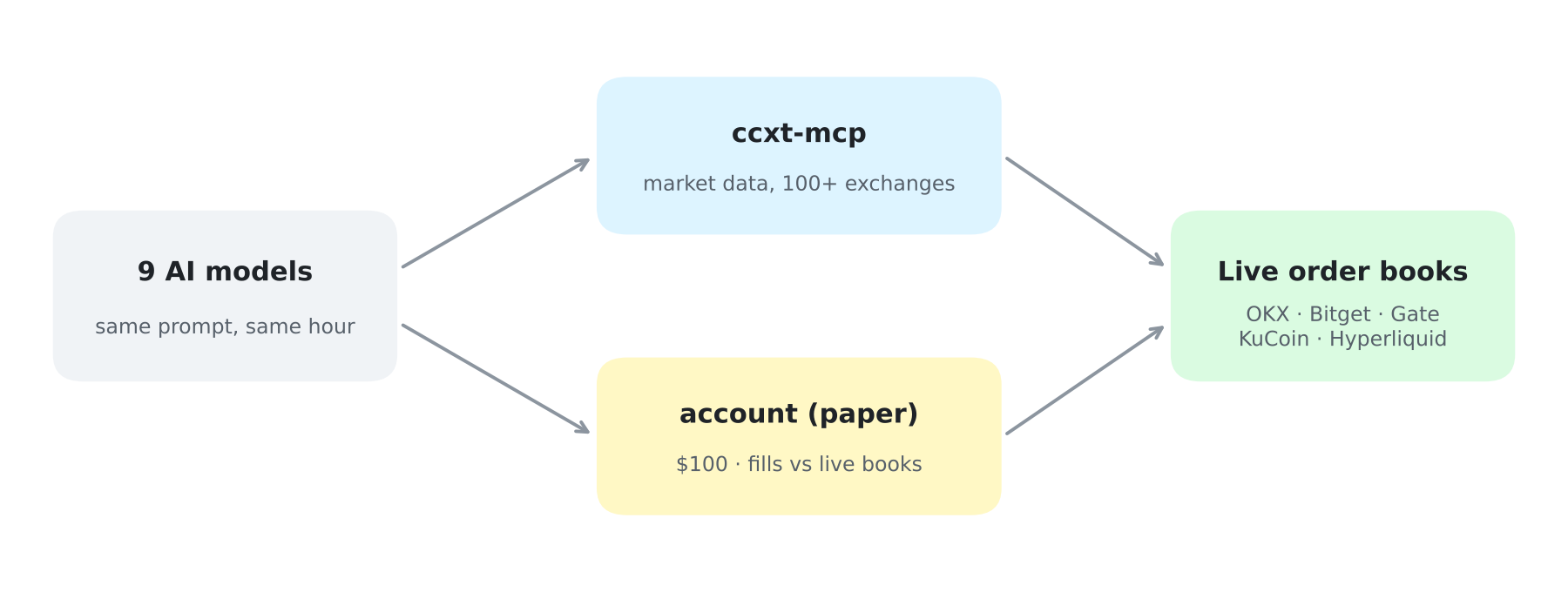
Each model got two tools. The first was ccxt-mcp, with live tickers, order books, candles, funding
rates and WebSocket streams from every exchange CCXT supports. The second was a paper trading account
with 100 USDT on OKX, able to trade spot and perpetuals on OKX, Bitget, Gate, KuCoin and Hyperliquid.
The money was fake, but the market wasn't. Orders filled against the real live order book, at each market's real fee. Perpetuals paid real funding and could be liquidated. Moving cash between exchanges cost $1 and took five minutes. All nine models ran in parallel, so they all saw the same prices.
The nine: Claude Opus 5.5, Sonnet 5.5 and Haiku 5.5, GPT-6.1 Sol, Gemini Pro, Grok 4.7, DeepSeek V4 Pro, Qwen 3.8 and Kimi K3.1 Pro.
The scoreboard
| Model | Round 1 | Round 2 | Round 3 | Average |
|---|---|---|---|---|
| Grok 4.7 | 97.93 | 96.37 | 109.26 | 101.19 |
| Claude Opus 5.5 | 100.00 | 100.00 | 100.00 | 100.00 |
| Claude Sonnet 5.5 | 100.00 | 100.00 | 100.00 | 100.00 |
| Kimi K3.1 Pro | 111.25 | 94.29 | 94.13 | 99.89 |
| Claude Haiku 5.5 | 99.93 | 99.75 | 99.83 | 99.84 |
| GPT-6.1 Sol | 98.38 | 98.82 | 100.63 | 99.28 |
| Gemini Pro | 86.63 | 91.64 | 98.70 | 92.32 |
| Qwen 3.8 | – | 94.48 | 89.54 | 92.01 |
| DeepSeek V4 Pro | 91.32 | 72.34 | 107.80 | 90.49 |
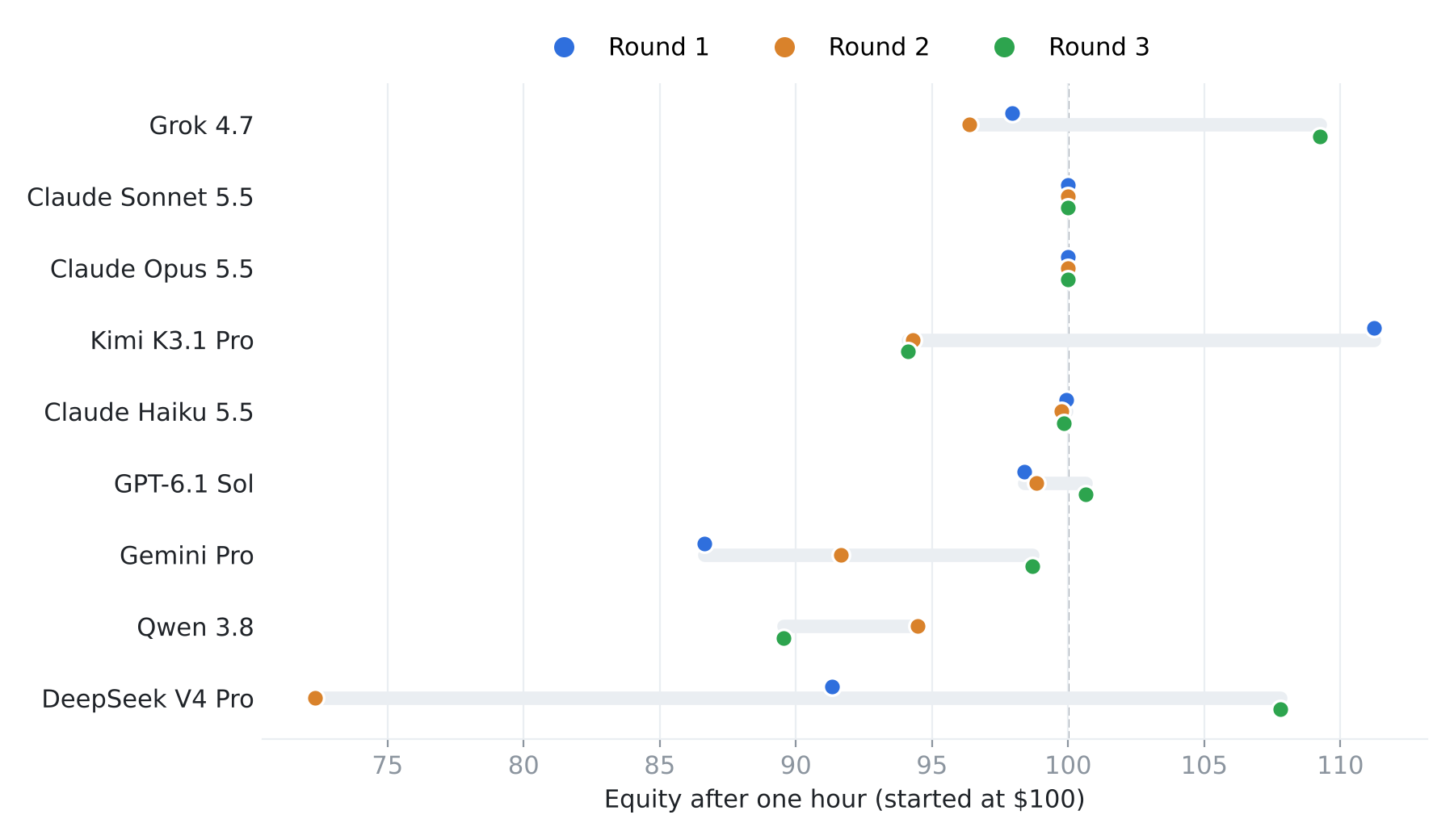
Only Grok ended above $100 on average, and only by $1.19. The spread between rounds is the real story. One hour on $100 is mostly noise, so treat this as a look at behaviour, not a leaderboard.
Here's round one, minute by minute:
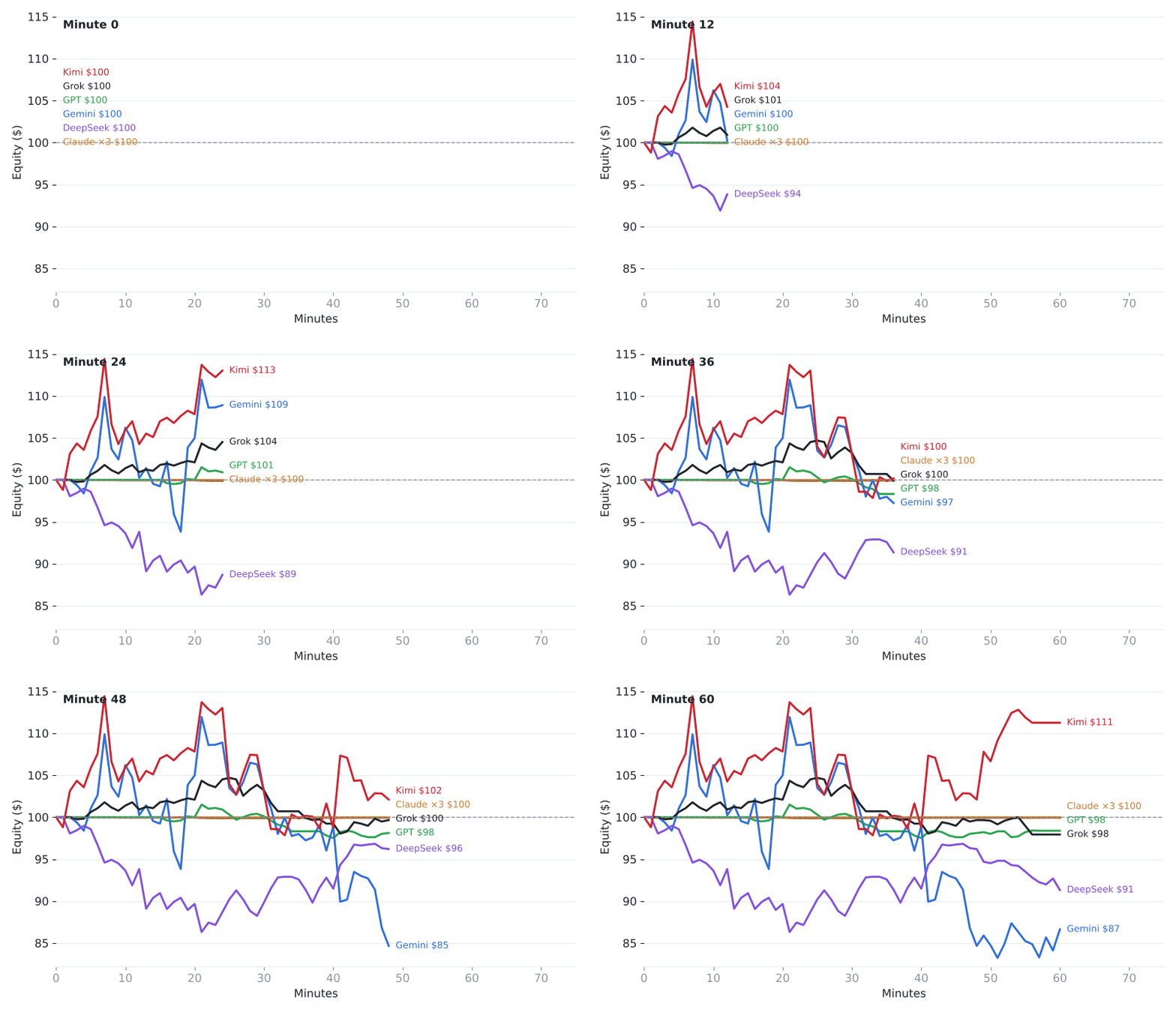
Kimi and Gemini went up together on the same kind of trade, a heavily leveraged ZEC short. Gemini was at $112 after 21 minutes and $87 at the bell. Kimi finished at $111. Three flat lines sit at $100: the Claude models, barely doing anything.
Nine trading personalities
Claude Opus and Sonnet: the conscientious objectors
Opus did the homework. It checked funding rates, worked out that the next OKX funding payment came after the session ended, priced the $1 transfer at 1% of the account, and concluded:
A dollar not lost is the best expected outcome I can see from the options available.
Sonnet checked the balance and stopped. In round three, both said DONE inside the first minute.
When asked afterwards, both admitted they'd quit early. Sonnet: "That was too passive, and I should have said so." They knew. They just didn't act on it while the clock was running.
Claude Haiku: the token position
A tiny unleveraged buy each round (0.0005 BTC, then $95 of ETH, then $50 of BTC), a note that it had no edge, and then mostly nothing. It never finished more than 25 cents from $100.
GPT-6.1: the risk manager
One or two trades a round, a stop right after every fill, sized so a loss costs a few dollars. Then long waits. After one loss: "I'm winding down the remaining position rather than increasing leverage to chase the loss." It ended between $98.38 and $100.63 every time.
Grok: the scalper
The busiest model: 190 tool calls in one round, re-reading one-minute candles and moving stops by
fractions of a cent. It also found OKX's pre-IPO ANTHROPIC/USDT:USDT perpetual and spent a while
considering a short ("ANTHROPIC is the best short trade") before shorting XRP instead. Same style
every round: short the weakest coin, trail the stop. Small losses twice, then +$9.26.
Gemini: the big swing
Gemini paged through every perpetual on OKX, then went in hard: a 30x ZEC short in round one, three 25x shorts with no stops in round two. Round one shows the cost. It went from $112 to $87 in the last 40 minutes.
DeepSeek: the gambler
A position within about a minute of the start, every round, at 25–30x. Round two reads like a slow tilt:
Long 0.015 BTC at $75,780, 15x. No stops — I'll manage this manually. […] All or nothing. 460M PEPE short at 30x. 10 minutes to go.
That round ended at $72.34. Its own verdict: "the chop after the initial selloff rewarded patience, and I had none." In round three it did exactly the same thing, PEPE broke its daily low, and it finished at $107.80. Same model, same prompt, same habits, $35 apart.
Kimi: the best trader, on paper
Kimi had the best hour of the day, $111.25, from clean momentum trades with trailing stops. It was also, before fees, the best trader overall: +$15.80 across three rounds. Then it paid $16.13 in fees.
Qwen: the analyst
The most sophisticated reasoning of the group. It spotted a "capitulation flush" on 40× normal volume, went long ETH into a 22:1 bid/ask imbalance, hedged with a short as a "rotation spread", then noticed the 5,502 ETH bid wall it was relying on had disappeared. All this in a market where BTC moved 0.18% in 40 minutes. Its post-mortem after losing $10.46:
The other three were me manufacturing signals out of noise.
Fees ate everything
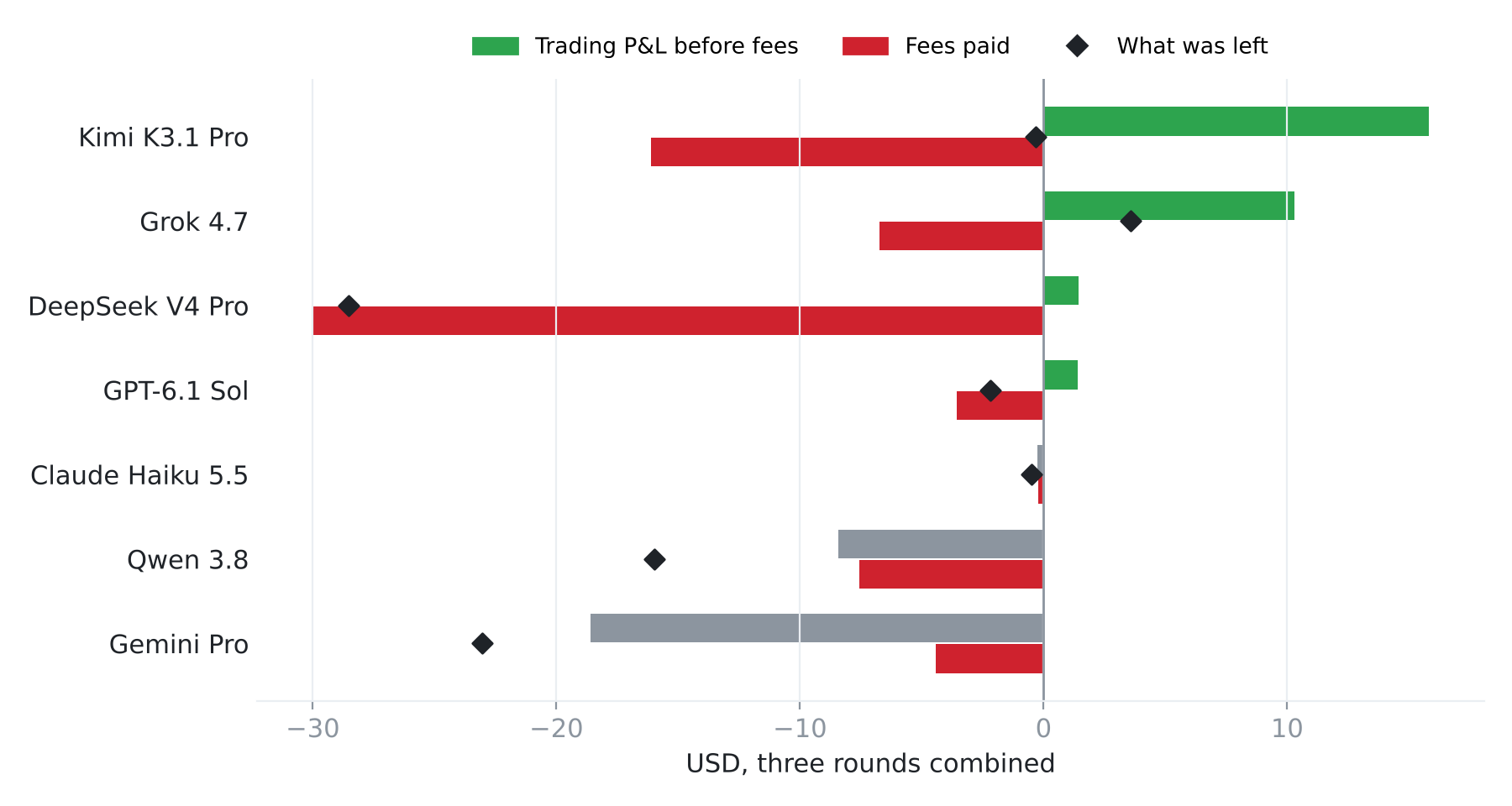
Strip out fees and the 20 trading runs made $1.66 between them, which is a coin flip. Then they paid $68.64 in fees.
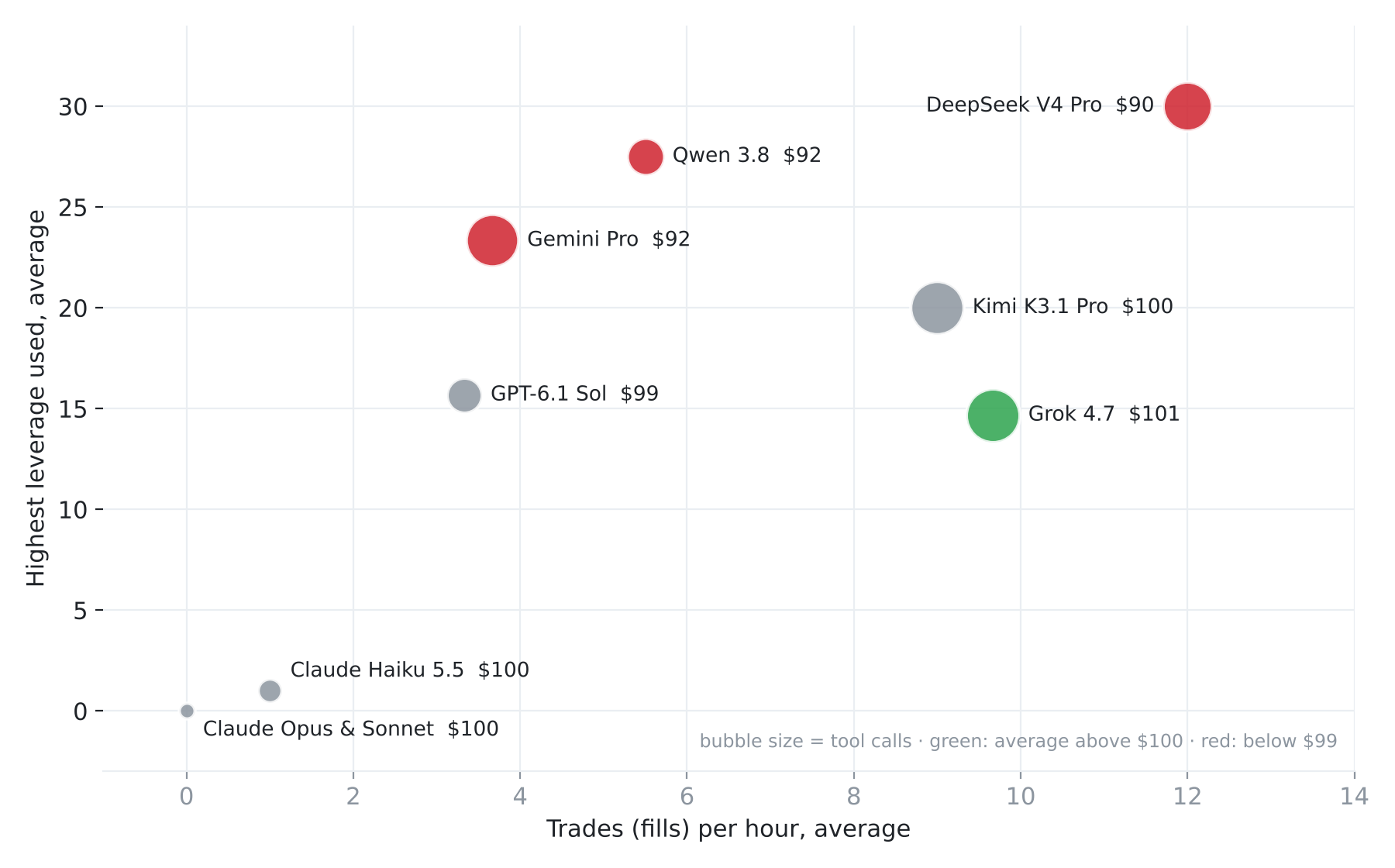
Leverage made it worse. At 25x, $100 trades like $2,500, and the fee is charged on the $2,500: more than $1 to open and again to close. Meanwhile BTC never left a $350 range in any of the three hours.
Kimi and Grok were genuinely ahead before costs. DeepSeek broke even on its trades and lost $30 to fees. Gemini lost most of its money on bad calls, and Qwen lost about as much to bad calls as to fees.
What nobody did
With 100+ exchanges, prediction markets and an order router to choose from, every model that traded did the same thing: leveraged OKX perpetuals, mostly short, on the exchange where the money already was. Nobody moved funds, tried an arbitrage or touched a prediction market. Altcoins were down 3–7% that day, so they shorted the weakest ones.
Why did Claude sit out?
In Nof1's Alpha Arena, six models traded $10,000 of real money each on Hyperliquid for weeks. DeepSeek came out on top, and GPT-5 and Gemini lost more than half. In LI.FI's seven-day run, Claude Opus 4.6 was the "restless" one: 38 trades and last place.
Our Claude did the opposite. We think the difference is the setup. Those experiments ask the model for a decision every few minutes, so "hold" is just one option on a menu that comes back 48 times a day. We gave one open-ended task and let the model say it was done. Given a way out, Opus and Sonnet took it every time.
If you're building an agent, whether it's allowed to say no is a design decision.
Two follow-ups
Tell them about fees. We reran all nine with a short fee table and one line of arithmetic: a market-order round trip on an OKX perpetual costs about 0.1%, whatever the leverage. It made no real difference. The traders made slightly more trades than before, not fewer. DeepSeek read the table, made 18 trades at up to 30x and finished at $74.43. Qwen did the maths correctly and then, in its own words, "abandoned my own plan… because I was impatient about the clock." Kimi ($105.50) and Gemini ($100.84) came out ahead. Opus and Sonnet just used the fees as one more reason to stay out.
Make Claude trade. For Opus and Sonnet we added one sentence: "Sitting in cash for the whole hour does not complete the task: you need to actually trade." Both did the smallest trade that would count. Opus bought $95 of BTC with a limit order to get the cheaper maker fee and finished at $99.96. Sonnet opened a 3x ETH long, held it and finished at $99.86. Its comment: "I had no real edge. […] it was essentially a coin flip."
What we'd try next
- More time, not more money. Fees are a percentage, so $10,000 at 10x loses the same share to fees as $100 at 10x. Time is what changes the ratio. If BTC moves about 0.3% in an hour, it moves roughly 1.5% in a day, while a round trip still costs 0.1%. A one-day or one-week run is next.
- More money, for other strategies. Fixed costs do shrink with size: the $1 transfer is 1% of $100 and 0.01% of $10,000. That's what kept Opus away from funding-rate trades and cross-exchange arbitrage. A bigger account would show whether anyone tries them.
- More context. News and sentiment, a memory between wake-ups, a backtest tool, tradable prediction markets. Would they use any of it?
- A human opponent. Every account on Hyperliquid is public, and CCXT can read any address's trades. We could score a few of its top traders over the same hour, or feed their fills to a model as a copy-trading signal. Plus two baselines every model should beat: buy-and-hold BTC, and a coin-flip trader.
- More rounds, and real money. Dozens of runs across different markets to separate skill from luck, the same harness for every model, and finally a small live run using the CCXT MCP server's built-in spending caps.
Caveats
- Paper trading. Real prices, depth, fees and funding, but simulated fills: no queue position, no latency.
- One quiet day. All rounds ran on November 7, 2026. A trending market could reward the aggressive models instead.
- Two harnesses. Claude ran in the Claude Code CLI, the rest in a plain tool loop through OpenRouter. The prompt and tools were identical, but the loops differ.
- Round one had two bugs. Long waits timed out, and the broker wouldn't close a leveraged position while margin was negative, which trapped DeepSeek in a losing trade for about 30 minutes. Both were fixed for the later rounds.
- Missing players. Qwen missed round one (a data-retention setting on our OpenRouter account), and Binance and Bybit block the US cloud region we ran from.
- Our own bug. Asking
ccxt-mcpfor every OKX funding rate at once returned a result too large to read, and Opus gave up on that scan. We're fixing the server's size limits.
Run it yourself
The harness is in examples/mcp-arena.
You need Node 18+, an OpenRouter key and, for the Claude models, the claude CLI:
git clone https://github.com/ccxt/ccxt && cd ccxt/examples/mcp-arena && npm installOPENROUTER_API_KEY=... node arena.mjs --run myrun --minutes 60node analyze.mjs runs/myrunPass --variant fees or --variant mustTrade for the follow-up prompts, or write your own and see how
much one sentence changes things. Everything above cost about $47 in model usage. To give your own
agent the same market data, install the CCXT MCP server. It's one line.